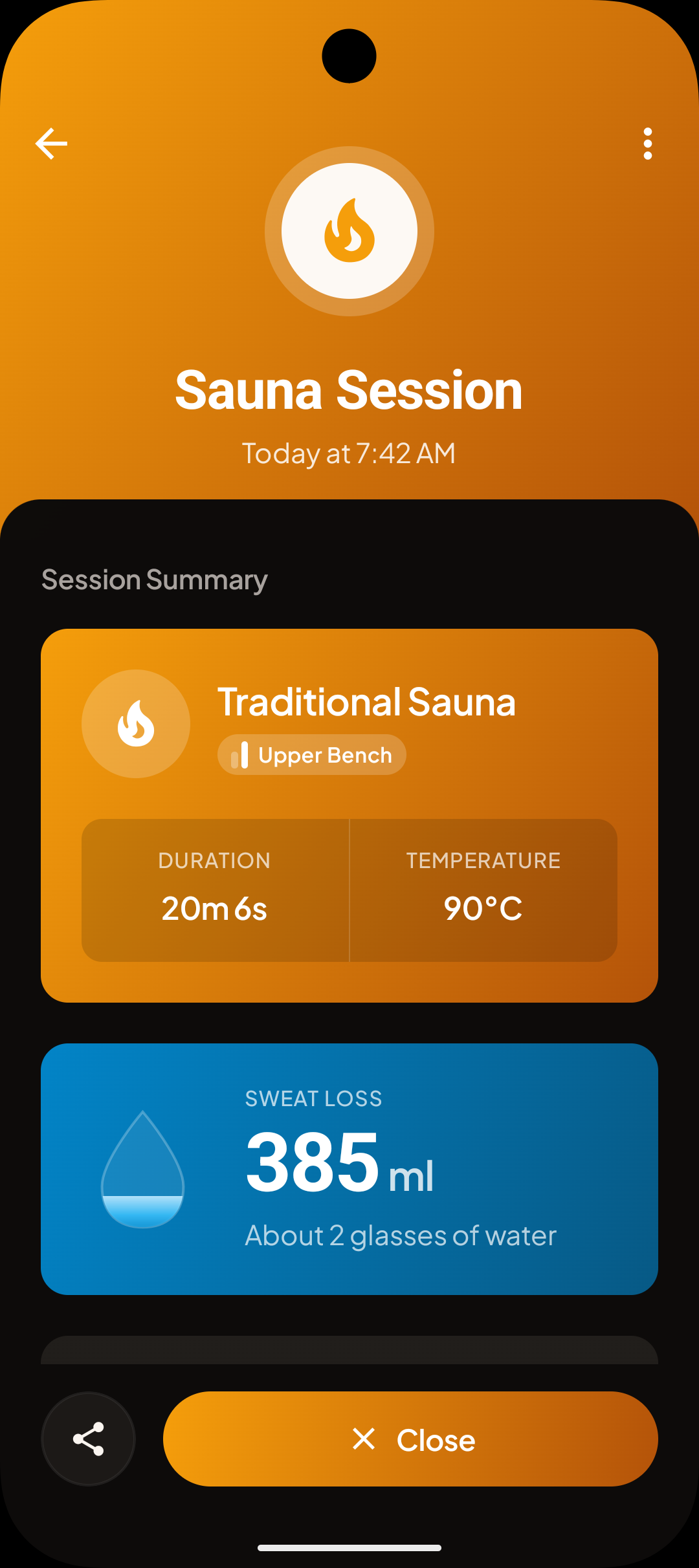
You step out of the sauna drenched, feeling like you just ran a marathon. But how much fluid did you actually lose? Understanding your sweat loss is essential for proper recovery — dehydration after sauna can leave you with headaches, fatigue, and diminished benefits from your session.
Here's what the research actually says about sauna sweat loss, and how to calculate your personal hydration needs.
The Short Answer: 0.5-1L Per Session
A typical 15-20 minute sauna session at 80-90°C causes most people to lose 0.5-1 liter of sweat. But this range varies significantly based on several factors we'll explore below.
The most comprehensive study on sauna sweat loss comes from Podstawski et al. (2014), who measured 674 participants across different sauna protocols. Their key finding: BMI is the strongest predictor of sweat loss, with a correlation coefficient of r=0.78-0.82 — stronger than raw body weight alone.
Factors That Affect Your Sweat Rate
1. Body Weight (The Biggest Factor)
Larger bodies produce more sweat, but it's not just about weight. The Podstawski research found that BMI (which accounts for height) is a better predictor than weight alone. The base sweat rate in a traditional sauna at 90°C is approximately 0.32 mL per kilogram per minute.
For example:
- A 60 kg person: ~19 mL/min → 384 mL in 20 minutes
- A 80 kg person: ~26 mL/min → 512 mL in 20 minutes
- A 100 kg person: ~32 mL/min → 640 mL in 20 minutes
These are base rates. The actual amount depends on several multipliers.
2. Temperature and Sauna Type
Sweat rate increases approximately 2.9% for every degree Celsius above the baseline temperature (based on Podstawski 2024 data showing 2.14× increase from 80°C to 120°C). A session at 100°C produces significantly more sweat than one at 90°C.
Different sauna types have dramatically different sweat rates:
| Sauna Type | Base Rate | Relative to Dry Sauna |
|---|---|---|
| Traditional (dry) | 0.32 mL/kg/min | 100% |
| Steam room | 0.16 mL/kg/min | 50% |
| Infrared | 0.16 mL/kg/min | 50% |
Why steam rooms produce less sweat: Despite feeling incredibly wet in a steam room, you're actually sweating about 50% less than in a dry sauna. This is due to a phenomenon called hidromeiosis — when your skin is fully saturated with moisture, the keratin rings around sweat pores swell and physically block sweat from escaping.
Research by Pilch et al. (2014) showed participants lost 0.36 kg in a wet sauna versus 0.72 kg in a dry sauna over the same duration — despite experiencing 38% greater core temperature rise in the steam room.
Much of the moisture you feel in a steam room is condensation from the humid air, not your own sweat. Isotope tracing studies found 30-54% of visible moisture on skin in steam rooms is environmental condensation.
3. Bench Level (Often Overlooked)
Here's something most people don't realize: where you sit dramatically affects your heat exposure.
In a traditional Finnish sauna, the thermometer is placed at seated head height on the top bench. Temperature drops approximately 10°C for each bench level:
| Position (2-tier) | Effective Temperature |
|---|---|
| Upper bench | 90°C (displayed) |
| Lower bench | ~80°C |
| Position (3-tier) | Effective Temperature |
|---|---|
| Upper bench | 90°C (displayed) |
| Middle bench | ~80°C |
| Lower bench | ~70°C |
This means sitting on the lower bench in a "90°C sauna" exposes you to the same temperature as the upper bench of an 80°C sauna. Your sweat rate adjusts accordingly.
4. Sex Differences
Research on sex differences in sweating shows conflicting results depending on the context. Lab-based passive heating studies (Gagnon & Kenny 2012) found women produce ~25-30% less sweat, with per-gland output ~42% lower.
However, actual sauna research tells a different story. Kirby et al. (2021) studied both sexes in real Finnish sauna conditions (101-108°C) and found both lost approximately 1.2% body mass — no significant difference in acute sweat loss.
The current best approach is sauna-type specific factors:
| Sauna Type | Female Factor | Rationale |
|---|---|---|
| Traditional | 0.85× (15% less) | Kirby 2021 showed similar acute loss in hot saunas |
| Infrared | 0.75× (25% less) | Slower heating resembles lab passive conditions |
| Steam | 0.75× (25% less) | Conservative default for humidity conditions |
The difference likely comes down to heating speed: traditional saunas hit you with immediate extreme heat, while infrared saunas heat more gradually (more like lab conditions where the larger sex difference was observed).
5. Age
Sweat rate decreases with age due to reduced sweat gland output and delayed sweating onset.
| Age Group | Relative Sweat Rate |
|---|---|
| Under 50 | 100% (baseline) |
| 50-64 | ~78% |
| 65+ | ~55% |
Research by Inoue et al. (1991) and Kenney & Munce (2003) documented a 30-45% reduction in sweat rate for older adults, along with progressive decline in thermoregulatory capacity.
6. Heat Acclimatization
Regular sauna users develop improved sweating efficiency. After 2-3 weeks of consistent use (2-3 sessions per week), your body adapts:
- Sweat gland activation increases up to 54%
- Sweating begins at lower core temperatures
- Maximum sweat rate increases up to 30%
This is why experienced sauna users often feel they "sweat more" than beginners — they actually do, and they start sweating sooner.
The Sweating Delay: Why Short Sessions Don't Work
Here's a crucial point many overlook: sweating doesn't start immediately.
Research shows there's a 5-10 minute delay before your sweat glands activate, depending on temperature and your acclimatization status:
| Temperature | Non-acclimatized Onset | Acclimatized Onset |
|---|---|---|
| 70°C | ~10 minutes | ~8 minutes |
| 80°C | ~8 minutes | ~6 minutes |
| 90°C | ~6 minutes | ~5 minutes |
| 100°C | ~4 minutes | ~3 minutes |
This means a 5-minute sauna session may produce minimal sweat regardless of temperature. Your body simply hasn't reached the core temperature threshold (~37°C) needed to trigger the sweating response.
Additionally, sweating follows an exponential ramp-up curve. It takes approximately 20-30 minutes to reach steady-state sweating. Short sessions produce proportionally less sweat than you might expect:
| Duration | % of Expected Sweat |
|---|---|
| 5 min (after onset) | ~41% |
| 10 min (after onset) | ~67% |
| 15 min (after onset) | ~82% |
| 20+ min (after onset) | ~100% |
How to Calculate Your Personal Sweat Loss
Here's a simplified formula based on the research:
Sweat (mL) = 0.32 × body weight (kg) × duration (min) × adjustments
Where adjustments include:
- Temperature factor: 1.0 at 90°C baseline, 1.29 at 100°C, 0.71 at 80°C
- Female (traditional sauna): multiply by 0.85
- Female (infrared/steam): multiply by 0.75
- Age 50-64: multiply by 0.78
- Age 65+: multiply by 0.55
- Steam room: multiply by 0.5
- Infrared: multiply by 0.5
- Lower bench: multiply by 0.8
Example: 75 kg male, 20 minutes, 90°C traditional sauna, upper bench
0.32 × 75 × 20 × 1.0 = 480 mL
Add ±20% for individual variation: 384-576 mL
How Much Should You Drink?
Sports medicine guidelines from the National Athletic Trainers' Association (NATA) and American College of Sports Medicine (ACSM) recommend replacing 125-150% of fluid losses. For a complete breakdown of sauna hydration timing and electrolyte needs, see our sauna hydration guide.
Why more than 100%? Because your body continues to sweat as it cools down, and some fluid is needed for normal metabolic processes.
| Estimated Sweat Loss | Recommended Fluid Intake |
|---|---|
| 300 mL | 400-450 mL |
| 500 mL | 625-750 mL |
| 750 mL | 950-1100 mL |
| 1000 mL | 1.25-1.5 L |
When Do You Need Electrolytes?
Per ACSM (2007) and NATA (2017) guidelines, electrolytes are primarily needed for extended heat exposure. For sauna sessions under 45 minutes with sweat loss under 1 liter, plain water is sufficient.
For longer sessions (45+ minutes) and higher sweat losses (1L+), consider adding electrolytes. Sweat contains sodium (230-2,070 mg/L depending on the individual), and extended heat exposure can deplete your electrolyte stores. A pinch of salt or an electrolyte drink helps maintain proper fluid balance.
The Bottom Line
Understanding your sweat loss isn't just about numbers — it's about optimizing your sauna practice. Under-hydrating leaves you with headaches and fatigue. Over-hydrating can dilute electrolytes.
The key factors to remember:
- BMI is the strongest predictor (not just body weight)
- Sauna type matters enormously (steam rooms & infrared = 50% less sweat)
- Bench position affects your effective temperature
- Duration should account for the 5-10 minute onset delay
- Rehydrate with 125-150% of estimated sweat loss
By tracking these variables, you can dial in your hydration and get the most from every session.
Sources
- 1. Podstawski, R., et al. (2014). Relationships between Body Composition and Different Protocols of Total Body Mass Loss during Finnish Sauna Bathing. Journal of Human Kinetics, 43, 183-193.
- 2. Podstawski, R., et al. (2024). Follow-up study comparing 80°C vs 100°C vs 120°C sauna sessions.
- 3. Gagnon, D., & Kenny, G. P. (2012). Sex differences in thermoeffector responses during exercise at fixed requirements for heat loss. Journal of Applied Physiology, 113(5), 746-757.
- 4. Pilch, W., et al. (2014). Comparison of physiological reactions and physiological strain in healthy men under heat stress in dry and steam heat saunas. Biology of Sport, 31(2), 145-149.
- 5. Kirby, N. V., et al. (2021). Independent and combined effects of fitness and heat acclimatisation on thermoregulation during exercise in the heat. Journal of Physiology, 599(18), 4471-4491.
- 6. Inoue, Y., et al. (1991). Regional differences in the sweating responses of older and younger men. Journal of Applied Physiology, 71(6), 9-14.
- 7. VTT Technical Research Centre of Finland (1992). Temperature stratification measurements in Finnish saunas.
- 8. American College of Sports Medicine (2007). Exercise and Fluid Replacement Position Stand. Medicine & Science in Sports & Exercise, 39(2), 377-390.
- 9. National Athletic Trainers' Association (2017). Position Statement: Fluid Replacement for Athletes.